

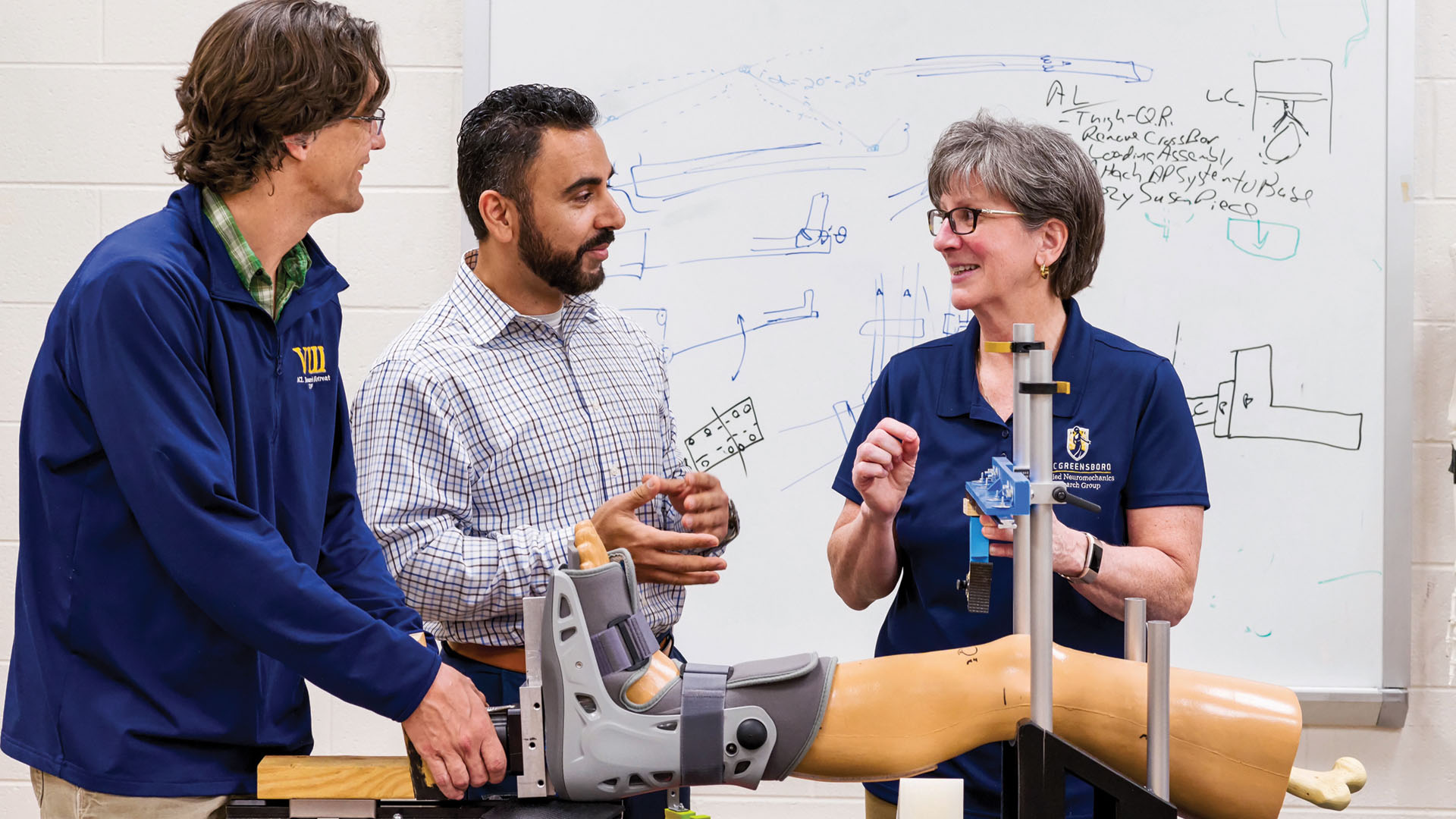
After years of hard work, Dr. Sandra Shultz (UNCG) and colleague Dr. Randy Schmitz (NC A&T, formerly UNCG) are seeing more than two decades of research pay off.
This past April, they earned a patent for a device that can help reduce the number of anterior cruciate ligament (ACL) injuries, especially in women athletes. The device is the GMetric3D Knee Joint Laxity Testing Apparatus.
It’s the result of teamwork, says Schultz. “This device was born out of evidence from our clinical research. I wouldn’t be at this stage without my co-inventor Dr. Randy Schmitz and our graduate students who partnered in this research over the past 22 years.”
What’s more, in May they were awarded a $600,000 grant from NC Innovations to move toward a market-ready device. Schultz believes it can make a real impact since ACL injuries are so common in sports.
Her research journey began with a question. Schultz wanted to know why women athletes were more prone to ACL injury than men.
She found one major reason for increased risk. “Most women and adolescent girls have greater laxity, or looseness, of the ligaments that stabilize the knee – a common risk factor for ACL injury,” she says. Simply put, too much laxity makes it more difficult to stabilize the knee, and that can lead to injury.
The GMetric3D Knee Joint Laxity Testing Apparatus screens for greater-than-average risk of ACL injuries, and it can be used to diagnose injuries or monitor post-surgery healing.
The UNCG faculty, staff, and students are exceptional people and professionals who have made this more of an adventure than work.
—Dr. Sandra Shultz
Schultz says that UNCG helped make it happen. “I’m a researcher, not a businessperson, so having a resource like LaunchUNCG and UNCG’s senior licensing associate Dr. Michael Marshall ’02 MS, ’14 PhD to walk me through the innovation steps was literally the difference between having a great idea on paper and turning it into a reality.”
Marshall says, “Sandy’s approach will give clinicians a lot more information and a more precise measurement than was possible with previous devices.”
This news comes as Schultz, the former director of UNCG’s Center for Women’s Health and Wellness in the School of Health and Human Sciences, retires from the University.
“UNCG has been a wonderful environment to work,” she says. “I appreciate that UNCG equally values teaching and research and works to provide the resources to equip faculty to succeed in both. All levels of administration have made every effort to help researchers be successful, and they are quick to celebrate success when it occurs.”
Though the device is not yet ready for the market, Shultz is optimistic about the next phase of development and grateful for the team around her. “It has been a privilege to be part of the Department of Kinesiology. The faculty, staff, and students are exceptional people and professionals who have made this more of an adventure than work.”
Read more about Schultz’ research here.