Alumni call it home. Moreover, it’s a festive spot for special events, a space for work that drives the University’s progress, and a place of inspiration for students.
“Look at this crowd. This is how America is supposed to be. People invested in the future. People encouraging one another, and this university stands as a beacon to that,” said Chancellor Franklin D. Gilliam, Jr. on a sun-drenched afternoon during Homecoming.
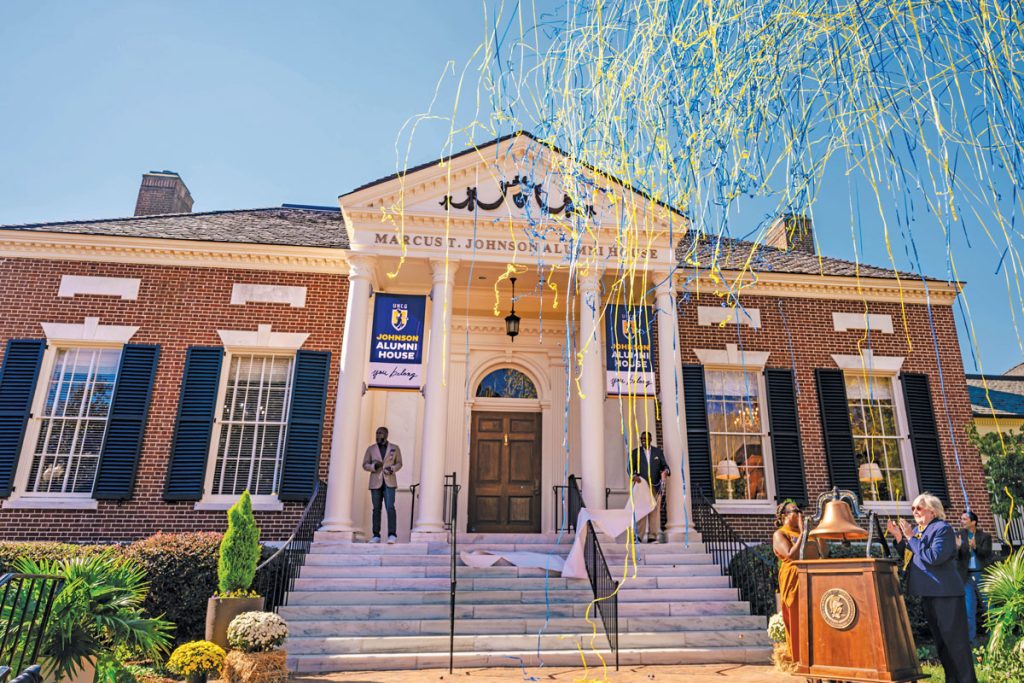
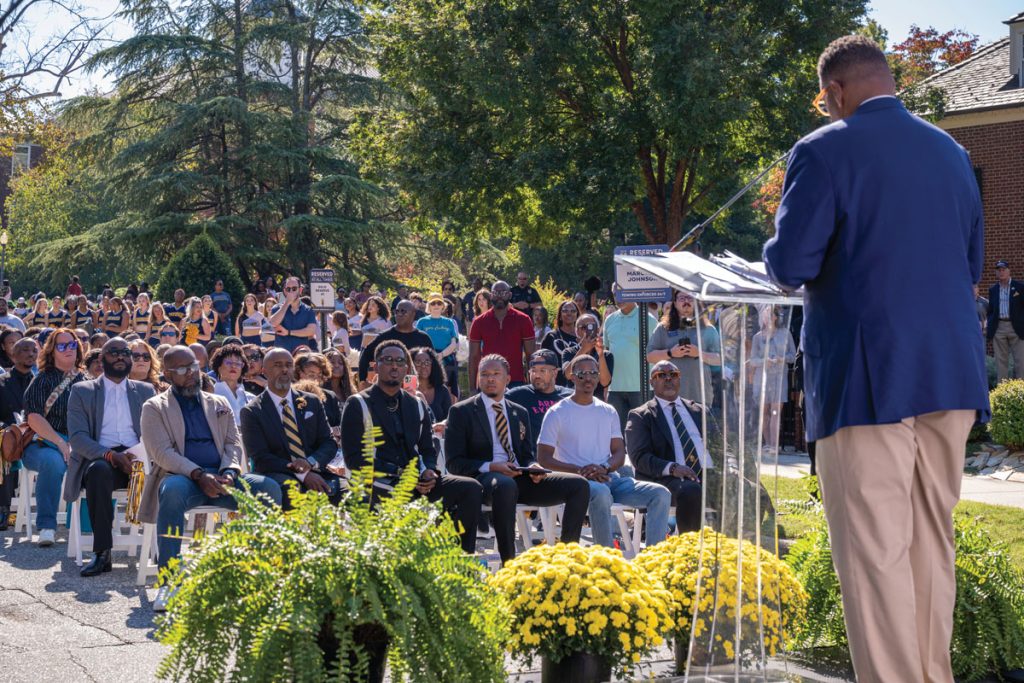
The air was rich with joy as a crowd of Spartans from all generations gathered to celebrate a significant milestone in UNCG’s story – the naming of the Marcus T. Johnson Alumni House, the first building on campus to be named for a person of color.
Johnson ’99 made a historic gift as part of UNCG’s Light the Way campaign.

“As an alumnus,” Board of Trustees Vice Chair Anita Bachmann said, “Marcus is investing in this building to preserve its legacy and ensure it remains a welcoming space that fosters connection and community, and we couldn’t be more grateful.”
The naming recognizes the impact of Johnson’s gift across multiple areas of campus. At the Bryan School of Business and Economics, his support will expand opportunities for students and bolster the innovative Bryan Blueprint Series, which helps accelerate students’ personal and professional growth.
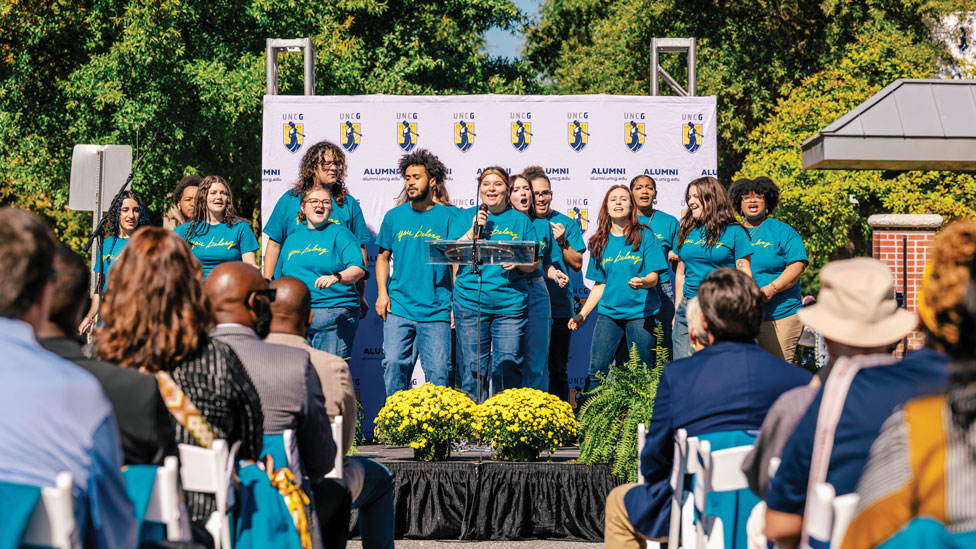
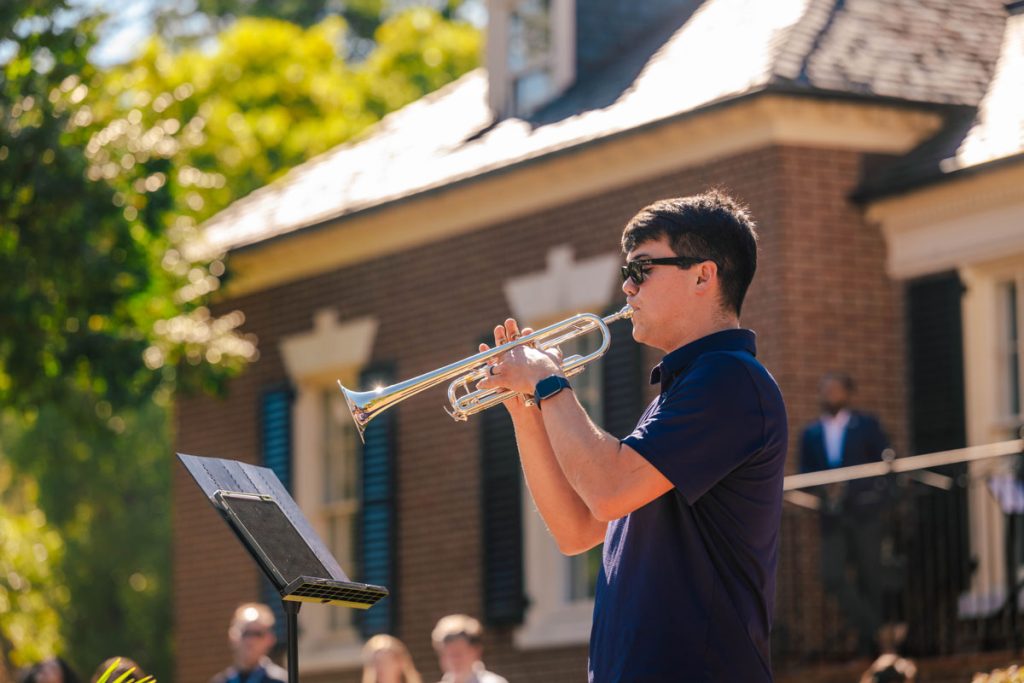
The ceremony began with the solo fanfare “Summon the Heroes,” a nod to Johnson as a trumpet player and to the legendary Miles Davis – one of his favorite artists and the inspiration behind his son’s name. Current students contributed throughout the event, including an a capella performance by the UNCG Chariots and a poetry reading by senior Seania Burnett:
The student presence at the event reflected Johnson’s deep commitment to UNCG’s future.
“Marcus’ historic gift is just one part of his impact,” Gilliam stated. “He shows up. He spends time with students, cheers on our Spartans, and serves on the Bryan School Advisory Board and the UNCG Foundation Board. He not only believes in UNCG’s potential; he’s energized by the vision of where we’re headed.”
Community was a theme of the ceremony’s speakers. Another was a commitment to greater opportunity for all North Carolinians, as it has been a guiding star for this campus since its start. “UNCG has always championed access to education – from our founding mission to educate women, to our ongoing support for first-generation students and social mobility,” said Gilliam. “Many of our graduates are ladders for their families, creating a ripple effect that leads to increased opportunity and success.”

Johnson’s story exemplifies the spirit of UNCG. Though initially drawn to theater, he followed his father’s advice and earned his business degree in 1999. He now leads Johnson Automotive Group, a prominent dealership founded by his father.
He is also the founder of MJonPurpose, which supports minority-owned businesses and mentors aspiring entrepreneurs, and a proud member of Alpha Phi Alpha Fraternity, Inc.
At the ceremony, Johnson’s fraternity brother Jaren Doby ’07, ’12 MSW shared, “Standing here today in front of a building that now bears the name of the first Black person ever honored at UNCG in this way is powerful beyond words. As a proud Greensboro native, I’ve seen firsthand how, over time, this University has opened its doors, creating spaces for voices like Marcus’, like yours, like mine, like ours – to rise, to overcome, to thrive, and to lead. What we witnessed today is more than just a name on a building. It is a declaration of possibility. It reminds us that our stories and contributions matter, that from the heart of Greensboro to this campus, excellence and quality have no limits.”
We’re proud of Marcus’ success as an alumnus – and even more proud of how generously he shares it.
—Chancellor Franklin D. Gilliam, Jr.
Marcus T. Johnson’s legacy thrives as UNCG names its first building for a person of color – the Alumni House, a space connecting students and alumni.


No place on campus fosters a warm feeling of community as well as continuity like the Marcus T. Johnson Alumni House. Created for graduates, students, and the campus at large, that feeling was its purpose from the beginning. Clara Booth Byrd, Class of 1913, the first long-term alumnae secretary, once said, “Alumnae House is really a link, actual and sentimental, with the beginnings of the college and the present University of North Carolina at Greensboro.” Barbara Parrish ’48, another well-remembered alumni secretary, said the same.
This is no mere House of brick and mortar and marble that we commemorate; it is built of ourselves.
—Clara Booth Byrd, Class of 1913, Alumnae Secretary
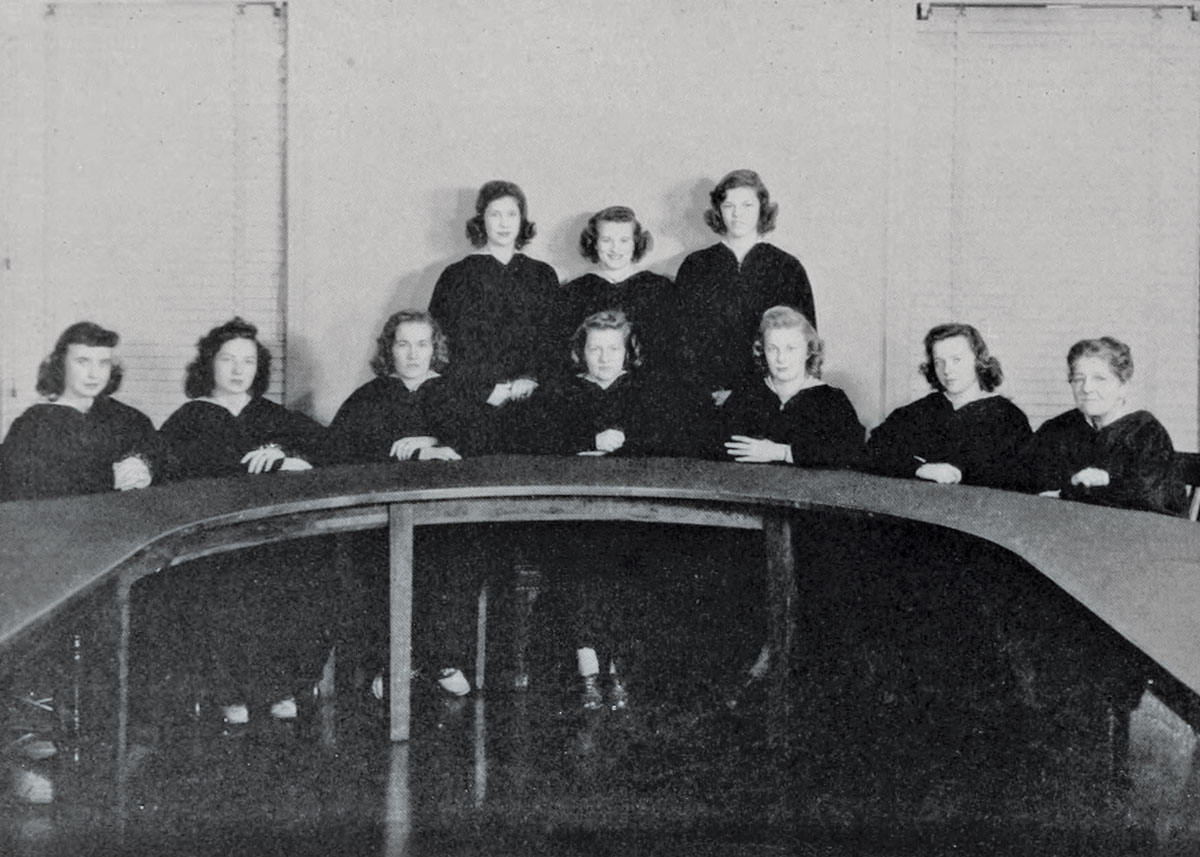
Upon its opening nine decades ago, the alumnae were exultant. It was only the seventh such alumni building in the nation. It was the only one built from funds raised by the widespread efforts of female graduates, History professor Richard Bardolph once noted – and only one of two alumni buildings with dedicated, furnished spaces for student activities.
It was on that gorgeous spring day in 1937 when the Alumnae House officially opened its doors – with a podium in front of the oak doors and hundreds gathered on the building’s lawn and College Avenue – the sun shone bright. So did the connection to the campus’ origins and to the future; they were on full display.
Every class had alumnae on hand. The 1930s, the Roaring Twenties. The WW I era, going back to the first class to receive bachelor’s degrees, in 1903. Even back to State Normal School days, when the campus doors first opened.
In fact, the very first student to enroll at our campus, Mary Dail (Dixon), Class of 1894, traveled from Raleigh to celebrate the Alumnae House, calling it “a perfectly thrilling time.”
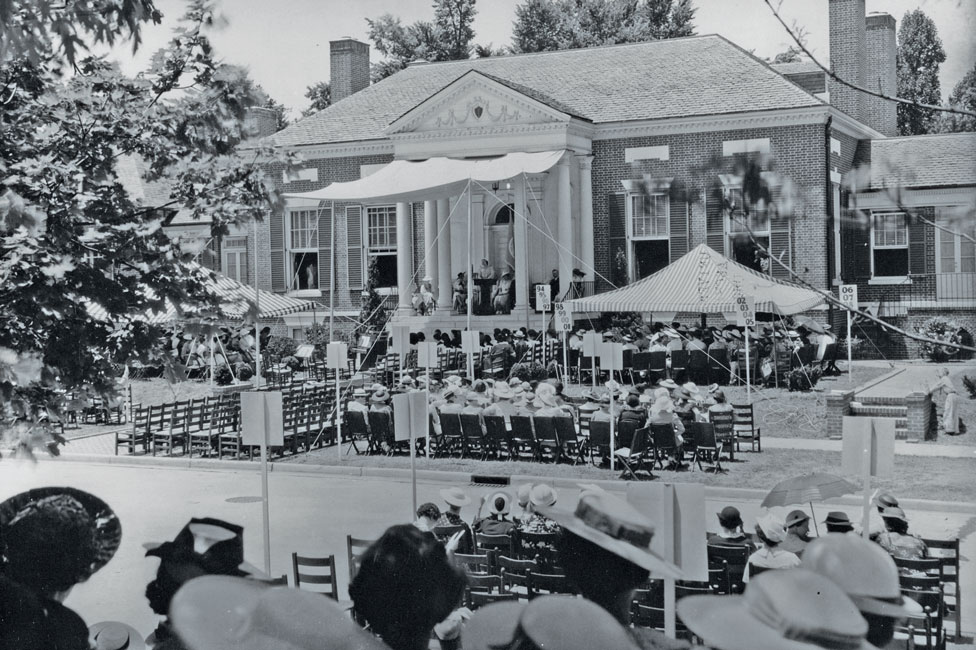
Coinciding with Commencement weekend, it was thrilling for all the alumnae as they celebrated what they’d accomplished for the college.
Byrd, widely lauded, along with President Julius I. Foust, for bringing the dream to fruition, told the alumnae assembled, “We have put our egg money into it. We have all but taken the clothes off our backs for the rummage sales that have gone into it.”
She referred to the paltry teacher incomes – and those making even less. “We have put our amazing teachers’ salaries into it. The dimes and the quarters of the maids and the janitors have gone into it. The gifts of our friends, they of the open hand and the generous heart, have gone into it.”
Leah Boddie, Class of 1921, and dean of women at New Jersey College for Women, gave the address.
The topic? “The Alumna, Today and Tomorrow.”
May Lovelace Tomlinson, Class of 1907, chair of the Alumnae House Building Committee, officially presented the building. She called that day a “Commencement Day,” alluding to a young graduate’s and her parents’ aspirations.
“The alumnae too dreamed dreams of making a contribution toward the development of this College along every line, socially, academically, financially,” she said. “As a result, in 1924 they launched a campaign to raise funds for this building, to which alumnae, students, faculty, and friends of the College contributed most generously.”
Plans were completed in 1932. But due to the Depression, construction did not begin until 1935, she noted.

Whatever there is in us of vision, courage, faith, and determination have been builded into its walls.
—Clara Booth Byrd, Class of 1913, Alumnae Secretary
The debt was paid off just before the ceremony. The final bank note was burned that day, President Foust holding the lit match to the paper. The ashes were preserved. The dramatic moment is part of UNCG lore – as is the mystery of what happened to those ashes.
“But at last, triumphantly we announce that our House is finished,” she proclaimed, “with all bills paid, and ready for the commencement of a life of service.”
That impactful “life of service” was soon seen to be profound. A student government president told the alumnae, “Student activity and enthusiasm have increased over 100 percent!”
An editor of The Carolinian student newspaper told the alumnae leaders that others may think of the building as the “college parlor,” but “to us it means a place where we can do our best work.”
Until 1953, when a student union (Elliott Hall) opened, the Alumnae House was astir with young voices and the clicks and bells of typewriters till late each evening, keeping the same 10 p.m. closing hours as the residence halls. Those Alumnae House memories were cherished for decades afterward.

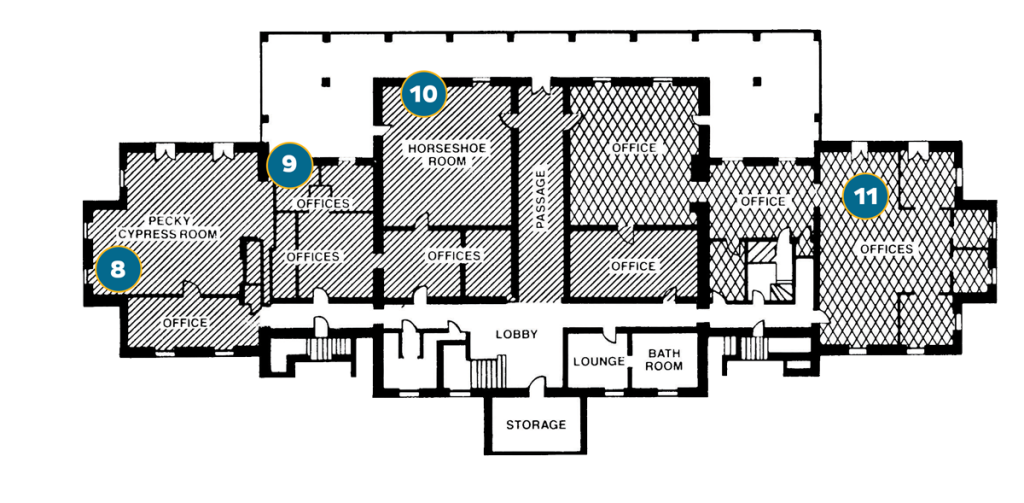
Ground Floor
First Floor
As a home for the alumnae leadership, its impact was even more pronounced. The Alumnae Association finally had a campus home, not just a makeshift space in Foust Building. It truly was a home – designed as a home, decorated as a home, even hosting overnight guests like a home. It welcomed all alumnae, the campus community, and, for special events, the greater community.
Since 1937, it has held the offices for alumni engagement leadership and staff members – and is the favored meeting spot when alumni boards take up an initiative or hold any gathering. That will never change, says Sarah Shoffner ’62, ’64 MS, ’77 PhD, chair of the Alumni House Committee.
She lauds its decades of constancy. “The Alumni House building is beautiful. It has been beautiful since it was built in 1937,” she said. “It’s always been here, and it’s always welcoming to alumni and friends.
“In addition to that, it has been a place where alumni could come and have weddings or receptions or memorials. It’s widely used.” Her son David and Kathryn Davis Shoffner ’93 had their wedding reception there, Shoffner proudly recalls.
Where it was originally conceived as a place drawing more closely faculty, students and alumnae, through the years its reach has broadened. “My hope for the building in the future is that it will be used even more than it is now,” Shoffner said, “and it’s pretty highly scheduled at this time.”
In recent years, an effort has grown to reestablish the Alumni House as a vibrant space for engaging students. Events hosted by the Office of Alumni Engagement, including study halls and the popular “Reading Day Recharge,” offer them an opportunity to connect and unwind before exams.
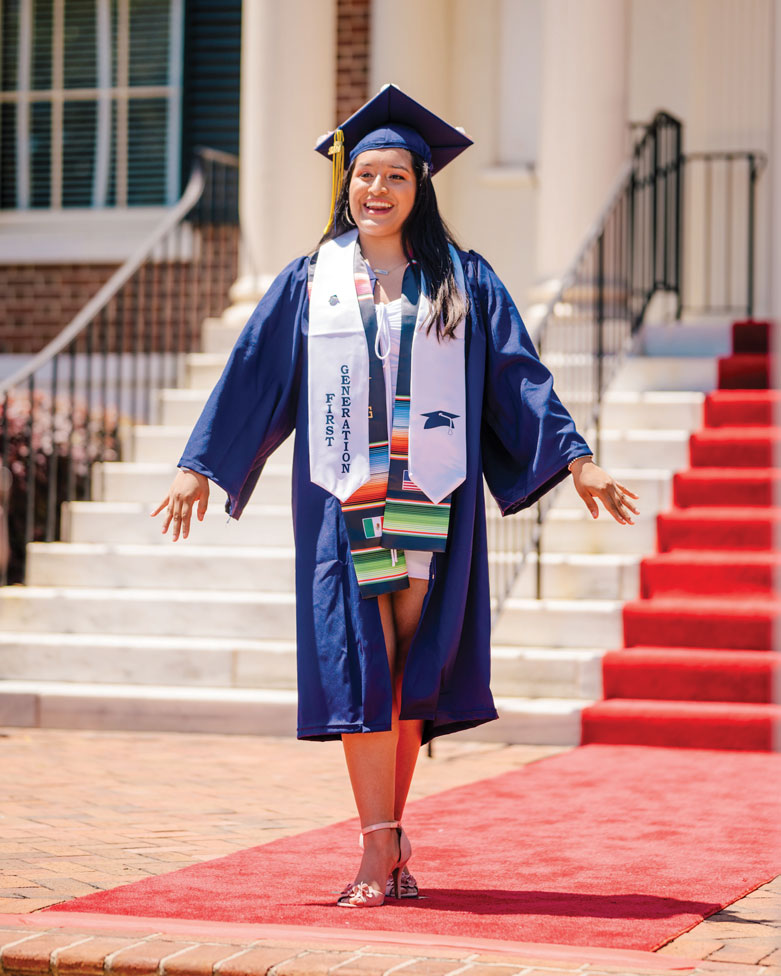
Taking a Commencement photo on the Alumni House steps has become a rite of passage for graduating Spartans each year, capturing their spirit of accomplishment.
As these traditions deepen and new ones develop, the space is destined to play an even greater role in connecting students and alumni – allowing Spartans of all generations to celebrate milestones and share common experiences.
The Alumnae House is a center of hospitality for the whole campus. … We alumnae have a right to feel that we are serving every day of our lives the present student generation, and the college as a whole.
—May Lovelace Tomlinson, class of 1907, chair of the Alumnae House Building Committee (as it opened), later president of the Alumnae Association
“I care about what UNCG has made the Alumni House stand for. It is also what I stand for – and that’s community,” Marcus Johnson explains.
“Community is a group of people with not just shared backgrounds, but shared values, shared experiences. It doesn’t necessarily mean that they come from the same background, but it is that breaking of bread, the ability to share, to be good listeners, and transparent enough to communicate what you believe to somebody else.”
When Marcus Johnson was a student in the ’90s, he never stepped foot in the Alumni House. He was not sure this elegant building was for him. Students tended to see it like a grandmother’s living room you’re reticent to enter.
“It’s now become ours,” he reflected recently. “It is very inclusive.”
“One of the things that I’m most excited about,” he continued, “is that students will have the opportunity to come in this building and realize, ‘Hey, that building’s named by a Spartan. And it’s the Alumni House, but I’m also welcome.”
At the close of the October naming ceremony, before the streamers flew and the name was unveiled, Johnson spoke about the importance of belonging – and his freshman year. It was a hard memory, the audience growing particularly quiet:
While living in the high rises, I experienced something that could have easily broken my spirit. A group of students who thought themselves superior wrote a racial slur on my door, in a marker for everyone to see. It read, ‘(Racial slur), you don’t belong here.’
For a long time, I wrestled with that word, ‘belonging,’ but over the years, I’ve learned that belonging isn’t granted – It’s claimed. …
My father once told me that the greatest thing you can do for your children is to leave them with a good education and a good name. My hope is that I’ve done that – not only for my children, grandchildren, and great-grandchildren – but also for someone else’s.
When you walk through this house, let it serve as a reminder:
You belong.
From a name once written on a dorm room door in hate to a name now written on a building in honor of you, I think it’s fair to say, ‘Checkmate.’
The applause echoed through the oldest part of campus – Foust Park, Centennial Park, and College Avenue – mixing with the happy sounds of a festive Homecoming on Spartan Way.
After the name was unveiled and the University Bell ceremoniously rang out, even more cheers, this time with streamers and confetti. Alumni and students gathered to talk and catch up and take photos. Johnson was surrounded by young well-wishers and old friends. Many attendees stayed even longer to enjoy a UNCG Archives exhibition on the history of the building.
It was truly a Homecoming for the ages.